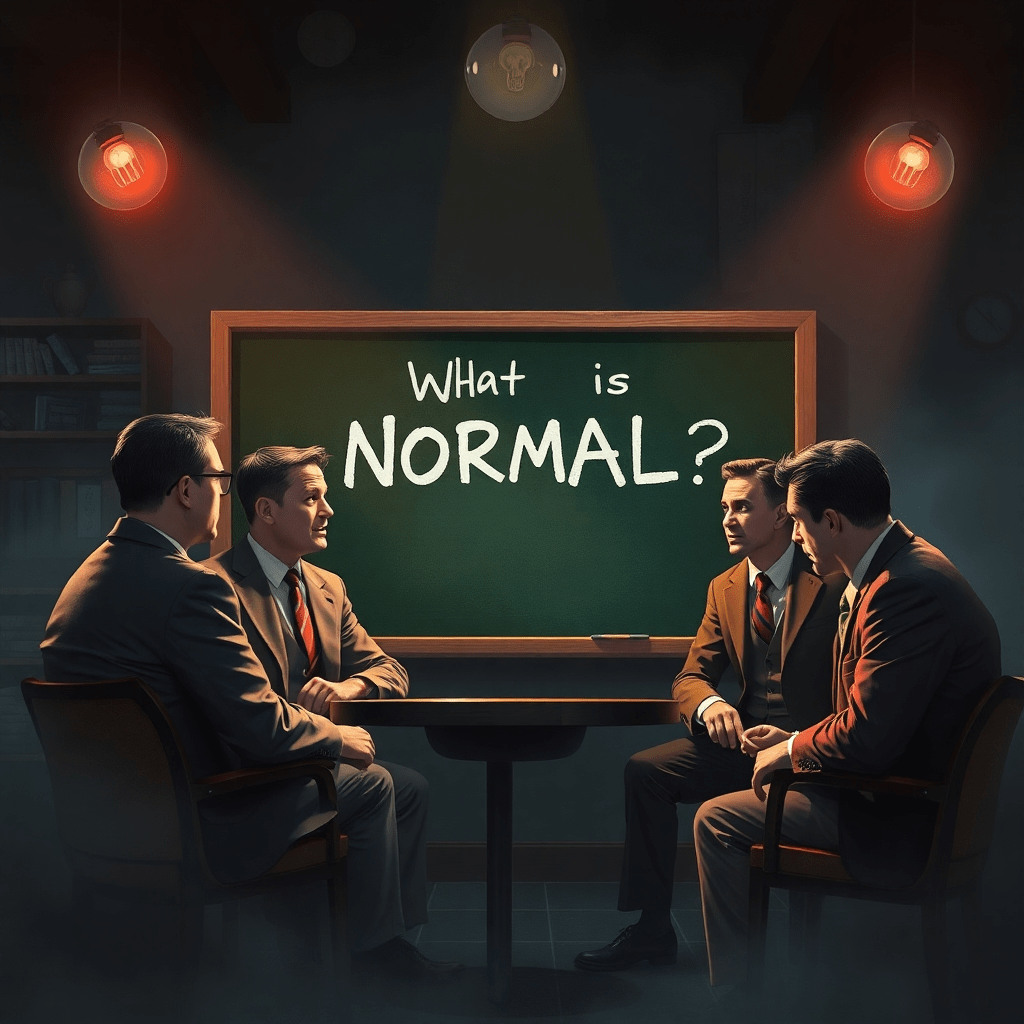
This past Saturday, I joined a round-table discussion group with several coaches. Our discussions lead from “change being effortless” to the use of labels like ADHD and PTSD. Not all rabbit holes are bad, and this one looked great to explore.
What is normal?
At some point, most of us have wondered: Am I normal? I know that growing up, that thought occurred to me more than once. It is normal to ask about our thoughts, feelings, or even how we experience the world. But what is normal? Who defines it? And why does it seem to shift over time?
The Ever-Changing Definition of Normal
What was considered normal 100 years ago is, in many cases, far from normal today. Social norms, cultural expectations, and medical and psychological standards have all evolved. A century ago, it was normal for children to work long hours in factories. It was normal to treat mental illness with institutionalization rather than care and understanding. It was even normal to view certain groups of people as inherently superior or inferior based on arbitrary factors.
“Normal is an illusion. What is normal for the spider is chaos for the fly.”
~ Charles Addams
Looking back, many of these ideas seem absurd, even cruel. But in their time, they were simply normal—accepted by the majority, reinforced by authority, and rarely questioned. Our definitions of normal continue to change. This raises an important question. If normal keeps changing, was it ever true to start with?
The Role of the DSM in Defining Normal
The Diagnostic and Statistical Manual of Mental Disorders (DSM) is one of the most influential books. It shapes what we see as normal. The American Psychiatric Association publishes the DSM. It categorizes mental health conditions. The DSM helps clinicians decide what is considered a disorder versus typical human experience. While it has undoubtedly provided structure and guidance, it has also been a moving target.
Consider this: Homosexuality was classified as a mental disorder in the DSM until 1973. Grief was once considered a natural process, but in some versions of the DSM, prolonged grief became a diagnosable condition. The line defining what we view as a disorder has always been subjective. It often blurs with what is simply part of the human experience. This line is influenced by cultural shifts, politics, and prevailing social attitudes.
This subjectivity raises important questions about the role of the DSM in shaping perceptions of mental health and illness. As society evolves, so does our understanding of what is normal and what is not. The inclusion or exclusion of certain conditions can have profound implications for individuals affected by them. These decisions influence everything from treatment options to societal stigma.
Moreover, the evolving nature of the DSM reflects broader trends in mental health awareness and advocacy. More voices are being heard, and more experiences are being validated. The criteria for what is deemed a disorder will continue to shift. For example, the increasing recognition of neurodiversity has led to a reevaluation of conditions like ADHD and autism. This encourages a perspective that emphasizes acceptance rather than pathology.
Critics argue that this fluidity can lead to over-diagnosis and medicalization of everyday struggles. Normal life challenges are often pathologized, but they should be understood as part of the human condition. This concern highlights the importance of clinicians understanding mental health with nuance. Clinicians need to balance diagnostic criteria with empathy and contextual awareness.
As we move ahead, we face a challenge. We must guarantee that the DSM remains a helpful tool. It should not become an instrument of exclusion or misunderstanding. We need to foster an environment where mental health is seen not only as a disorder. It should also be viewed as a spectrum of experiences. This includes emphasizing our innate resilience, our real-time coping strategies, and our grounding in well-being. Ultimately, the goal should be to support individuals in their unique journeys while respecting the complexity of the human experience.
When Did We Start Worrying About Normal?
Human beings have always been social creatures, wired for connection and belonging. But the obsession with being normal seems to have intensified in the modern era. Industrialization brought standardization in many aspects of life—education, work, and even personal behaviour. Psychology and medicine aim to categorize and treat human conditions. This contributed to a growing focus on identifying what is typical versus atypical.
“The reward for conformity is that everyone likes you except yourself.”
~ Rita Mae Brown
Today, social media accelerates this pressure. We are constantly bombarded with images of what life should look like. They tell us how we should feel, what we should achieve, and even how we should suffer. The quest to be normal can sometimes feel like a never-ending comparison game.
The line between reality and representation blurs as we scroll through social media feeds filled with picture-perfect moments. The pressure to conform to these ideals can lead to feelings of inadequacy, anxiety, and isolation. We innocently measure our worth against the highlights of others’ lives. We forget that behind every polished image lies a complex story. These stories are often filled with hidden struggles and imperfections.
In this environment, the concept of normal becomes a double-edged sword. On the one hand, striving for what is deemed ‘normal’ can provide a sense of belonging and security. It fulfills the need to belong. It offers a framework within which many feel comfortable operating. On the other hand, it stifles individuality and diversity. It pushes people to suppress their unique traits, experiences, and emotions to fit into a predefined mould.
Moreover, the relentless pursuit of normal can contribute to a culture of silence around mental health issues. Those who struggle feel compelled to hide their challenges for fear of being seen as ‘abnormal.’ This perpetuates a cycle. Vulnerability is equated with weakness. Seeking help becomes an act of courage that few are willing to take.
As we navigate this landscape, it’s essential to cultivate spaces where authenticity is celebrated rather than shamed. Embracing our differences and recognizing that there is no singular way to experience life can foster resilience and connection. By challenging the notion of what it means to be ‘normal,’ we can create communities that uplift rather than undermine. In these communities, everyone feels valued, listened to, and accepted for who they truly are.
Ultimately, the journey towards self-acceptance involves redefining our understanding of normal. It invites us to ask difficult questions about society’s expectations and our own beliefs. Are we striving to be normal because it aligns with our values? Or is it simply what we have been conditioned to pursue? In finding answers to these questions, we discover a path toward a more inclusive and compassionate world. In this world, normal is redefined by authenticity rather than conformity.
A Different Perspective: Beyond Normal
Rather than asking, “Am I normal?” What if we asked, “Am I okay?” What if we saw human experience as a spectrum rather than a rigid standard? The Three Principles suggest we understand that we live in the feeling of our thoughts. These thoughts shift from moment to moment. As a result, our experiences also change. What we experience isn’t a diagnosis—it’s simply thought in motion. When we realize this, the pressure to be normal fades. It is replaced by a deeper trust in our innate resilience and well-being.
“If you are always trying to be normal, you will never know how amazing you can be.”
~ Maya Angelou
This shift in perspective allows us to embrace the full range of our emotions and experiences without fear or judgment. Instead of striving for that elusive ideal, let’s acknowledge that feeling the full spectrum of emotions is natural. You are not broken! We experience these feelings throughout our lives. By asking ourselves, “Am I okay?” we open the door to self-compassion and acceptance, recognizing that it’s okay not to be OK sometimes. We find ourselves in a feeling. You are not the feeling. The words “I am sad” are inaccurate. You feel sad as a description; you are not a sad person.
In this way, we cultivate a more nurturing relationship with ourselves. We learn to honour our feelings as valid expressions of our current state of mind. They are not reflections of our worth or identity. This journey encourages us to explore our thoughts with curiosity. We should approach them without fear. We understand that they are transient and do not define us. All things shall pass like any storm cloud in the sky.
Moreover, viewing our experiences through this lens makes us more empathetic towards others. We recognize that everyone navigates their unique spectrum of thoughts and feelings. This understanding fosters connection and compassion. It allows us to support one another in struggle without the pressure to conform to cultural norms.
“If the only thing people learned was not to be afraid of their experiences, that alone would change the world.”
~ Sydney Banks
Ultimately, embracing this perspective empowers us to navigate life’s ups and downs more easily. We see that every feeling is part of the human experience. True well-being comes from within—not fitting into a predefined normal mould. Focusing on whether we are okay at any moment creates space for growth. It also allows for healing. We achieve a deeper understanding of ourselves and those around us.
So the better question isn’t What is normal? But instead, Does normal even matter?
Share Your Thoughts
I’d love to hear your perspective on this. Have you ever felt labelled as anything other than normal? What does normal mean to you? Share your thoughts and experiences in the comments or reach out—I’d love to continue the conversation.
Kind regards,

Here is a talk Sydney Banks gave in 2000 at a Washington, D.C. conference. He discusses the role of thought and separate realities.
Here is a little more inspiration…

 Rick Ruppenthal | COACHING