This is part two of a three-part series on leadership this week. If you missed part one, here it is. Leadership – Beyond the Noise
Seeing the Whole Again
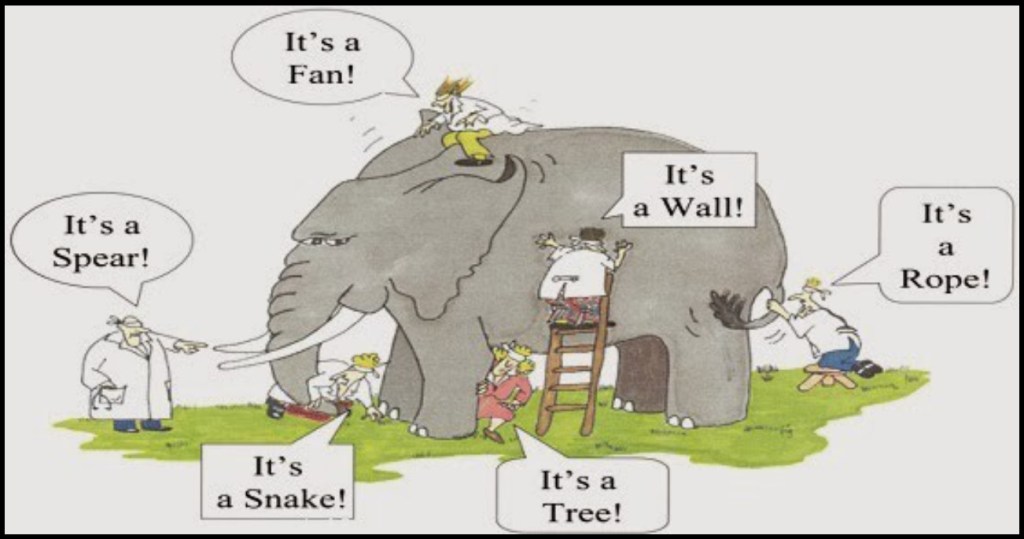
There’s an old parable you may know.
A group of blind men encounter an elephant for the first time.
Each touches a different part.
One holds the trunk and says, “An elephant is like a snake.”
Another feels the leg and says, “No, it’s like a tree.”
Another grabs the tail. Another the ear. Another the side.
Each is convinced they are right.
Each is sincere.
Each is touching something real.
And each is completely missing the whole.
I’ve been thinking about that story a lot lately.
Because it feels uncomfortably familiar.
When partial truth hardens into certainty
Most of us are not trying to be dishonest.
We’re not trying to be cruel.
We’re not trying to lose our conscience.
We’re holding onto something real.
A statistic.
A story.
A lived experience.
A value we care deeply about.
A moment that shaped us.
The problem isn’t that we’re touching nothing.
The problem is what happens next.
We stop exploring.
We stop listening.
We stop wondering what else might be here.
And then, quietly, without malice, conscience narrows.
The danger isn’t disagreement — it’s collapse
Disagreement is healthy.
It’s inevitable.
It’s human.
What’s dangerous is collapse.
The collapse of complexity into labels.
The collapse of people into positions.
The collapse of living systems into nouns.
Conservative.
Liberal.
Republican.
Victim.
Villain.
Woke.
MAGA.
Enemy.
Threat.
Catholic.
Conservative.
There. Done.
Once the label is applied, curiosity shuts down.
Once curiosity shuts down, conscience flattens.
Once conscience flattens, anything can be justified.
And this is where the parable turns from philosophical to practical.
Tom Chi and the speed of judgment
In his TEDx talk, Tom Chi describes how fast this happens.
A tenth of a second.
That’s all it takes for the mind to assign a label — and stop seeing.
Not because we’re bad people.
But because the brain loves efficiency.
Labels save energy.
They simplify the world.
They reduce uncertainty.
Imagine a world where no one named a fork. How would you ask for it?
But they also reduce humanity.
Conscience cannot survive without humanity.
Seeing the elephant doesn’t mean denying harm
Let me be very clear here.
Seeing the whole does not mean:
- Pretending harm isn’t happening
- Excusing abuse of power
- Neutralizing moral responsibility
- Retreating into “everything is relative” thinking
Some things are wrong.
Some actions cause real damage.
Some systems harm people.
Conscience requires that we name that.
But naming harm is different from collapsing people into caricatures.
You can say, “This behaviour is wrong,”
without saying, “You are nothing but this behaviour.”
You can oppose injustice
without losing your capacity to see.
That’s the difference between moral clarity and moral certainty.
The moment conscience disappears
Here’s the moment to watch for, in yourself, not just “out there.”
It’s the moment when:
- You no longer feel curious
- You feel righteous instead of grounded
- You stop asking questions
- You assume motives
- You feel relieved because you “finally understand what’s really going on.”
That relief is seductive.
It feels like standing on solid ground.
But often, it’s just gripping one part of the elephant and calling it the truth.
Reality versus abstraction (again)
Tom Chi asks a question worth repeating:
“Is this reality — or is this an abstraction?”
Reality is uncomfortable.
It moves.
It contradicts itself.
It refuses to stay neatly categorized.
Abstraction is comfortable.
It sits still.
It agrees with us.
It doesn’t ask us to change.
And when abstraction wins, conscience shrinks to the size of our label.
A quieter kind of wisdom
What if wisdom isn’t loud?
What if it doesn’t announce itself with certainty,
but whispers with curiosity?
What if wisdom sounds like:
- “I may be seeing only part of this.”
- “What else might be true?”
- “What am I not seeing yet?”
- “What would it mean to stay human here?”
That kind of wisdom doesn’t trend well either.
But it does something far more important.
It keeps us from becoming blind while holding something real.
A question to sit with
Before the next conversation.
Before the next post.
Before the next certainty hardens.
Try this:
Which part of the elephant am I holding… and what might I be missing?
That question doesn’t weaken conscience.
It strengthens it and invites wisdom to show up.
Part 3 is where we turn this inward seeing into outward action —
where courage shows up, not as outrage, but as grounded participation in reality itself.
Part 3 coming soon.
Much love,

If this reflection resonated, here’s a short talk worth watching. Jonathan Haidt explores how good, well-intentioned people can look at the same reality and see something completely different, not because one side is evil, but because they’re responding to different moral intuitions.
It’s a helpful companion to the idea of holding part of the elephant while mistaking it for the whole.
Sometimes an ancient story says it better than any argument.

 Rick Ruppenthal | COACHING
One thought on “Understanding Conscience Beyond Labels”